5 proven setups + exact measurements
Small living rooms aren’t hard because you “don’t have enough furniture.” They’re hard because one wrong spacing decision (a sofa pushed too far forward, a rug that’s too small, a TV that’s off-center) can make everything feel cramped.
This guide gives you 5 layouts that work in real homes, with exact measurements you can follow. Pick the setup that matches your room shape, then copy it. No guessing.
Before you choose a layout: the 6 measurements that matter
Grab a tape measure and write these down:
- Room width × length
- Door swings (which way doors open)
- Traffic path (where people naturally walk through)
- Window locations (and radiator/AC units)
- TV wall options (where glare is lowest)
- Your largest piece (sofa length and depth)
If you only remember one rule:
Protect the walkway first, then place furniture.
Small-room “comfort numbers” (use these everywhere)
- Main walkway: 80–90 cm / 31–35 in
- Between sofa and coffee table: 40–45 cm / 16–18 in
- From sofa edge to rug edge: 20–30 cm / 8–12 in visible border
- TV viewing distance: 1.5–2.5× screen diagonal (rough guide)
- Side table height: within 2–5 cm / 1–2 in of sofa arm height
Layout 1: The Classic “Sofa + Media Wall” (Best for rectangles)
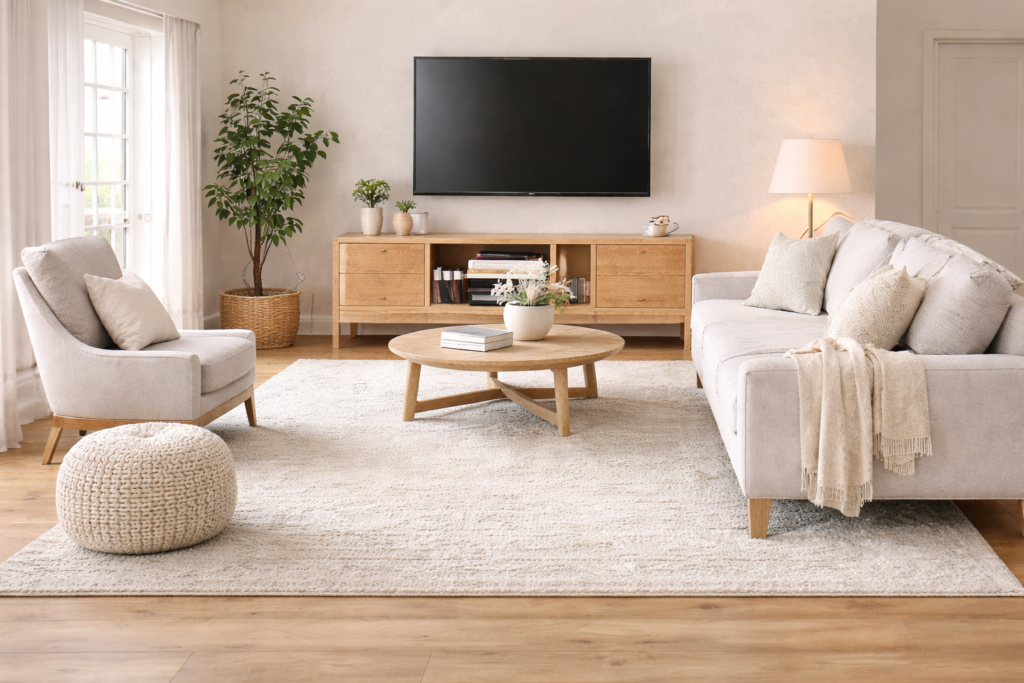
Best for: narrow rectangular rooms, most apartments
Feels like: clean, easy, balanced
What you need
- 1 sofa (180–220 cm / 71–87 in)
- 1 rug (160×230 cm / 5×7 ft or 200×290 cm / 6×9 ft)
- 1 coffee table (90–110 cm / 35–43 in long)
- Optional: 1 accent chair or pouf
Exact placement
- Place sofa on the long wall (or opposite the TV wall).
- Place TV/console centered on the opposite wall.
- Position coffee table so there’s 40–45 cm / 16–18 in between it and the sofa.
- Leave 80–90 cm / 31–35 in walkway behind the coffee table zone if there’s a path through the room.
Rug rule (this fixes 70% of small-room problems)
- Rug should go under the sofa’s front legs by at least 15–25 cm / 6–10 in.
- If your rug is too small, choose one size up—it makes the room look bigger.
Layout 2: The “Floating Sofa” (Best for open-plan spaces)
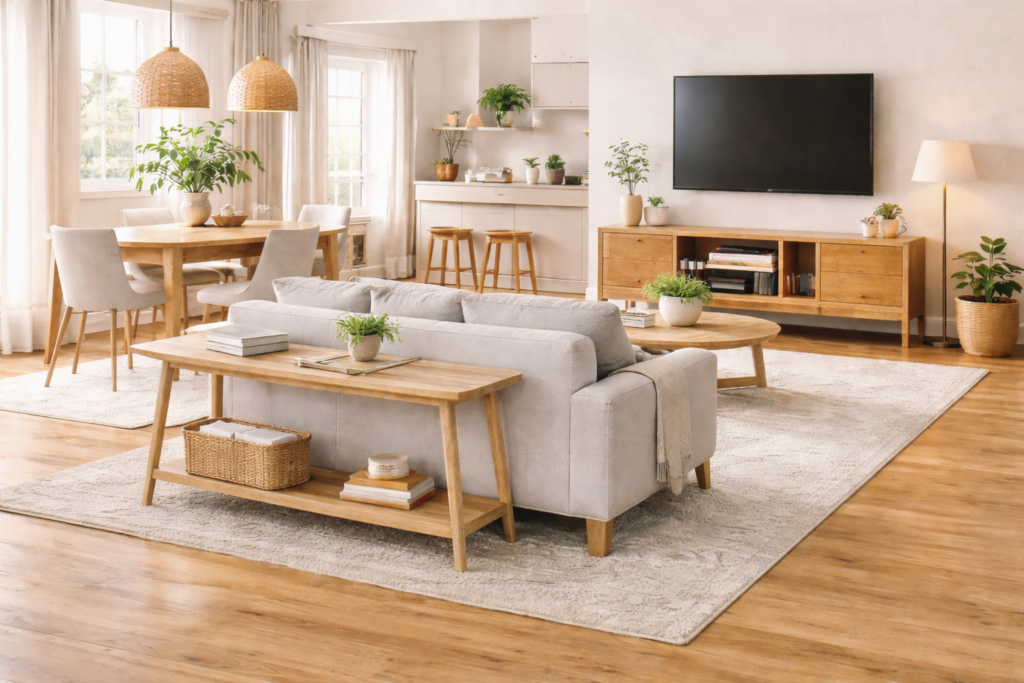
Best for: open living/dining, studio apartments
Feels like: intentional, “designer” zoning
What you need
- Sofa (any size that fits)
- Console table or low shelf behind the sofa (optional but powerful)
- Rug (at least 160×230 cm / 5×7 ft)
- Media wall or TV stand
Exact placement
- Pull the sofa 20–30 cm / 8–12 in away from the wall.
- Keep 90 cm / 35 in clear behind it if it’s a walkway.
- Center rug under the seating zone (front legs on rug).
- If possible, add a slim console behind the sofa: depth 25–30 cm / 10–12 in.
Why it works
Floating the sofa creates a “room within a room.” Even tiny spaces feel structured.
Layout 3: The “Corner Sectional Done Right” (Best for families)
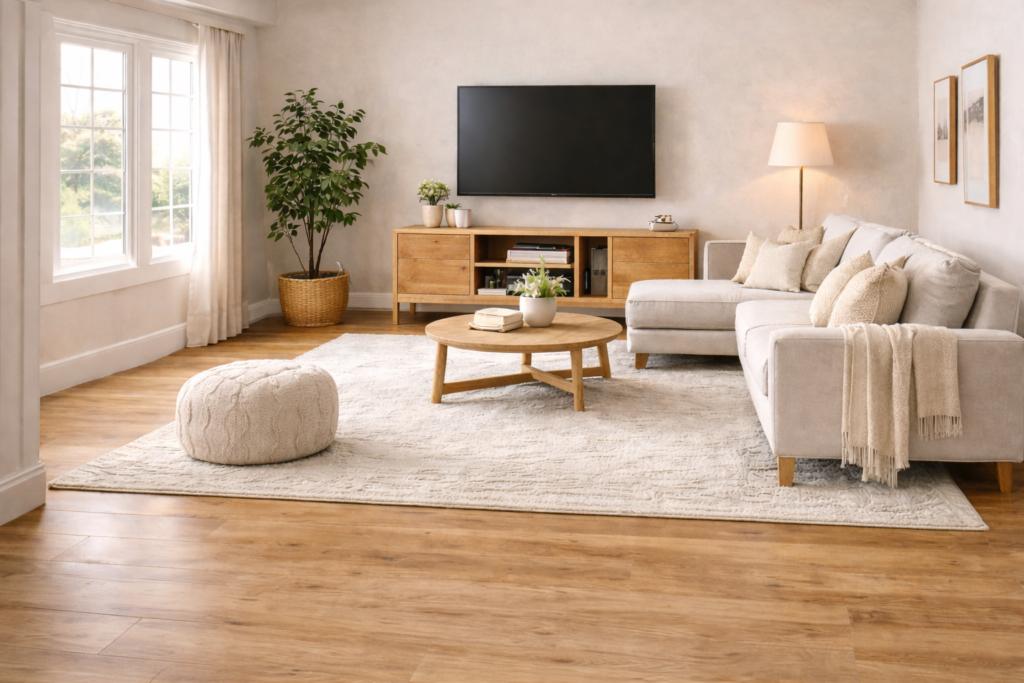
Best for: movie nights, kids, lounging
Feels like: cozy, efficient
What you need
- Small sectional (ideally 220–260 cm / 87–102 in total span)
- Rug (200×290 cm / 6×9 ft if possible)
- Coffee table or ottoman
- Optional: 1 armless accent chair
Exact placement
- Put the sectional in the corner furthest from the main traffic path.
- Leave 80–90 cm / 31–35 in walkway on the “open” side of the room.
- Coffee table spacing stays the same: 40–45 cm / 16–18 in.
Pro tip
If the sectional overwhelms the room, swap the coffee table for a smaller ottoman (60–80 cm / 24–31 in) to keep movement easy.
Layout 4: The “Two Chairs + Small Sofa” Conversation Setup
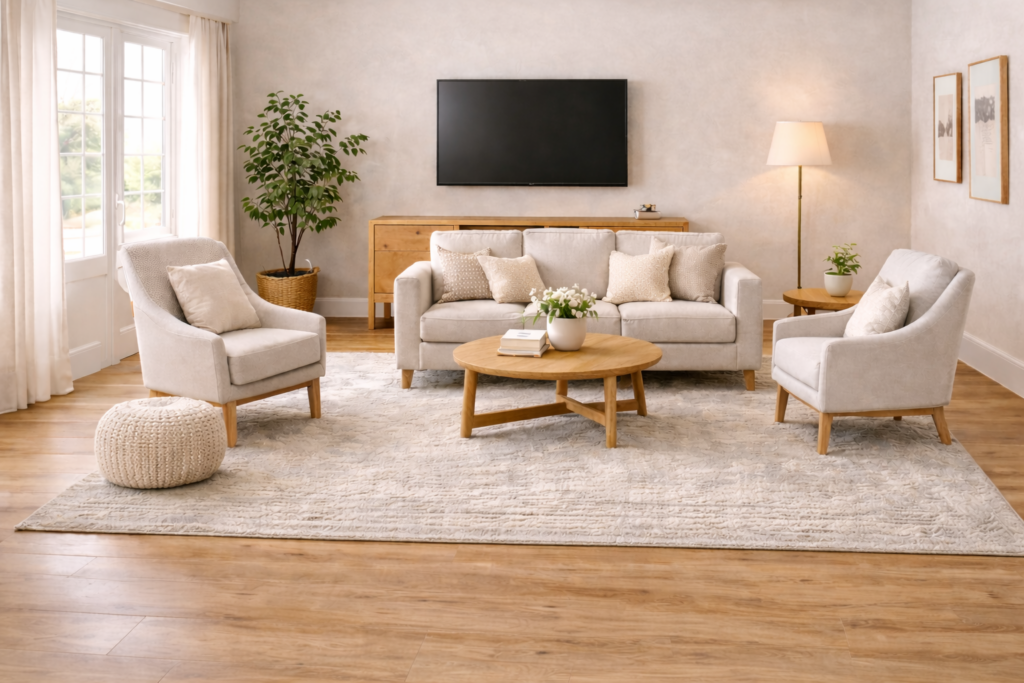
Best for: people who actually talk more than watch TV
Feels like: airy, social
What you need
- Small sofa (160–190 cm / 63–75 in)
- 2 slim chairs (or 1 chair + 1 pouf)
- Round coffee table (best for tight spaces)
- Rug (160×230 cm / 5×7 ft)
Exact placement
- Sofa faces the chairs, not the TV.
- Keep 60–75 cm / 24–30 in between chairs and sofa edges (comfortable talking distance).
- Choose a round coffee table: diameter 70–85 cm / 28–33 in.
- Maintain 40–45 cm / 16–18 in from seating to table edge.
Why round tables win
They remove sharp corners and make narrow walkways feel easier.
Layout 5: The “No-Table / Ottoman + Side Tables” (Best for tiny rooms)
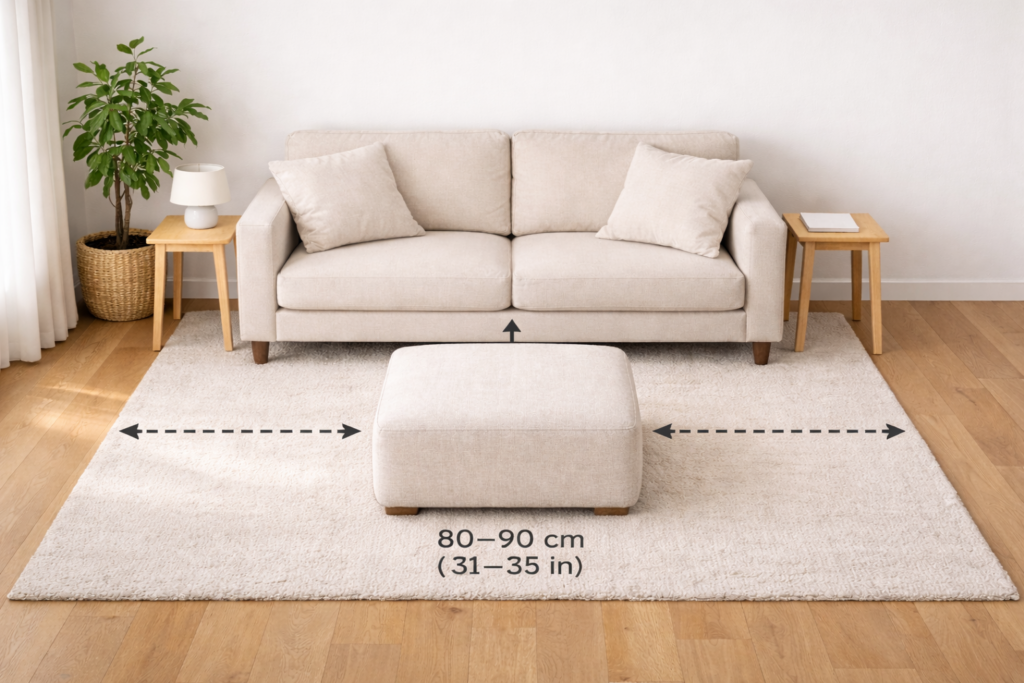
Best for: very small living rooms where a coffee table blocks traffic
Feels like: flexible, uncluttered
What you need
- Sofa or loveseat
- 1 soft ottoman (or 2 small poufs)
- 1–2 side tables (or wall-mounted shelves)
Exact placement
- Replace the coffee table with an ottoman: 60–90 cm / 24–35 in wide.
- Put side tables at the sofa arms (height within 2–5 cm / 1–2 in of sofa arm).
- Keep the center path as open as possible: 80–90 cm / 31–35 in.
Why it works
You get function without the “big rectangle” blocking the room.
Quick size guide (so you don’t buy the wrong things)
Best rug sizes for small living rooms
- 160×230 cm / 5×7 ft = minimum for most small rooms
- 200×290 cm / 6×9 ft = makes the room feel larger (if it fits)
Best coffee table sizes
- Length: ½ to ⅔ of sofa length
- Height: 2–5 cm / 1–2 in lower than the sofa seat height
Best TV console depth (small room)
- 35–45 cm / 14–18 in (keeps the wall streamlined)
Common mistakes that make small rooms feel smaller
- Rug too small
- Furniture pushed against every wall
- Oversized coffee table
- No clear walkway
- Too many bulky pieces (swap in poufs, armless chairs, nesting tables)